 EN
 Polski (PL)
 Deutsch (DE)

Contrary to appearances, exterior doors are a complex structure. Individual models can differ in a number of ways, including their construction, the materials used, and specific parameters such as strength or thermal performance.
These factors directly impact the comfort and safety of the home’s occupants. Therefore, before deciding to purchase exterior doors, it’s worth learning as much as possible about their key characteristics.
One of the fundamental issues to consider when choosing a specific model is its construction. It determines not only the door’s strength and sound insulation but also its aesthetics—and thus affects the appearance of your house or apartment.
Panel or solid-core: what’s the difference in the construction of exterior doors?
Online, you’ll come across various classifications of exterior doors and terminology that can be confusing to a layperson. One of the key distinctions concerns paneled and solid-core doors.
The former are also sometimes referred to as stiles-and-rails or framed doors, because the construction of their door leaf is based on stiles and rails—two vertical and two horizontal elements that form a frame visible at first glance.
BARAŃSKI panel doors—how are they built?
The stiles in BARAŃSKI panel doors are made of pine wood that has been laminated in alternating layers. This construction ensures the door’s strength and greater resistance to temperature changes and other external factors compared to single-piece (solid) constructions.
Construction of exterior rebated panel doors
The frame is filled with a panel (hence the “alternative” name: panel doors). It typically consists of panels and glass, although the specific design depends on the manufacturer. In the case of BARAŃSKI doors, the panel consists of a decorative coffered section, partially filled with a 42-mm-thick insulating panel.
The connection between the panel and the stile is reinforced with a metal profile and a solid oak strip. The joint is visible as a recess, which is why the panel is, in a sense, set “back” within the frame composed of stiles.
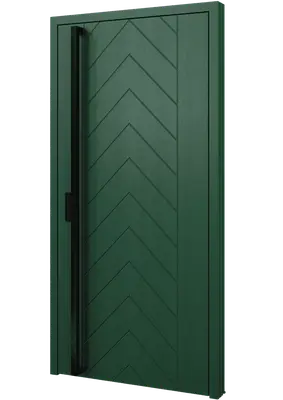
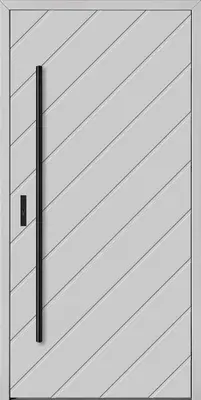
Panel doors also feature stiles, but they are concealed beneath the structural panel. This panel covers the frame with its infill, which, as a result, is not visible as it is in paneled doors. Therefore, there is no difference in the surface levels of the door.
In BARAŃSKI panel doors, the stiles are constructed similarly to those in paneled doors. The difference is that they are reinforced with two metal channel sections, which further increase the door’s resistance to deformation or bending. The core consists of a thermal insulation panel, which is 60 mm thick for rebated door leaves and 72 mm thick for non-rebated ones.
Rebated and non-rebated panel doors—how do they differ?
For structural reasons, doors can also be classified as rebated or non-rebated. In the BARAŃSKI product line, this distinction applies only to panel doors. Paneled doors are available exclusively in a rebated design. What is the difference?
In this case as well, the difference is visible to the naked eye. In a non-rebated door leaf, the hinges are concealed within the door frame and invisible from the outside, so the door does not protrude from the frame. This creates a sleek, modern look and makes the floor area appear larger.
In non-rebated doors, the hinges are concealed within the door frame
In contrast, in rebated doors, the hinges are visible, and the edge of the door panel overlaps the door frame. The advantage of this type of construction is the simplicity of installation and the ease with which the hinges can be adjusted. Rebated door leaves are a classic solution that remains quite popular and has its supporters for aesthetic reasons as well.
Thicker exterior doors mean greater durability and improved security
In the case of panel-construction doors, the thickness of the thermal insulation panel is significantly greater than in paneled doors, which translates to better thermal insulation and soundproofing performance. The outer panel of the door leaf in panel-construction doors also makes them more resistant to external factors and mechanical damage.
This is basic information about the construction of exterior doors. When choosing a specific model, it’s worth keeping the above distinctions in mind, as they determine both the aesthetics and functionality of the door—including the level of security it provides for the household.