 EN
 PL (PL)

To put it simply, a door consists of a frame—also known as a stiles—and a panel. The frame, in turn, can be made of laminated wood or wood-based panels (most commonly MDF).
- Honeycomb—this is a cardboard insert shaped like a honeycomb. It is the cheapest material, but also the least durable. Although manufacturers often emphasize that they use materials with increased strength or even “heavy-duty honeycomb,” it’s important to remember that the core of the door consists of paper. If you strike such a door hard enough, you’ll likely punch right through it. Doors with honeycomb core are mass-market products—easily available but of lower quality. At “Barański,” we do not use this construction material.
- Particleboard is a wood-based product made by compressing wood chips or fibrous wood-like raw materials bonded with synthetic adhesive. Particleboard is characterized by much higher strength than honeycomb panels and also provides better sound insulation. We use this material to manufacture select models of technical doors from the Barański Smart line. For interior doors, we use perforated particleboard, which is lighter than standard particleboard.
- MDF (Medium Density Fiberboard) is a stronger version of particleboard, with higher density, manufactured at a higher temperature. It is more resistant to damage than standard particleboard, but it is also heavier. We primarily use MDF for the production of doors from the Barański Optimo line. HDF (High-Density Fiberboard) is also sometimes used in door manufacturing, though it is less popular than MDF.
- Wood is the only natural core material. For door production, wood is cut and then laminated in layers to increase the structure’s durability and strength. Most doors from the Barański Premium line are made of this material.

Smart doors, which incorporate wood, MDF, and particleboard.
It’s also worth knowing two more terms related to types of interior doors: veneered and laminated. Veneered doors are covered with a natural veneer—a layer of thin wood sheets—and protected with varnish. Veneer looks very similar to solid wood—the wood’s structure and grain are clearly visible. This material is sourced from both domestic and exotic woods.
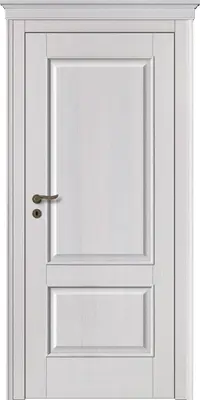
Merkury A model interior wooden doors—speckled ash finish
Laminated doors, on the other hand, are finished with a cellulose fiber veneer—that is, a laminate that can imitate wood or come in a solid color from the RAL palette. Laminates vary in thickness and resistance to abrasion and moisture. In Barański Optimo doors, we use exclusively modern laminates from the CPL veneer group (CLPL slow, multi-layer pressing technology) and PP polypropylene laminates, which guarantee long-lasting and safe use of the doors. A drawback of laminates is the limited ability to repair very deep scratches or the inability to refresh the door’s surface, unlike with veneered doors finished with varnish.
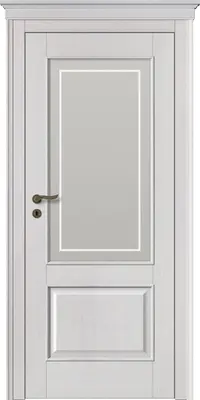
RETRO A.3.0 laminated interior door in White Speckled Oak
Wood or MDF? Or perhaps another construction material?
Why are we comparing only wood and MDF when there are other construction materials available? Honeycomb core has so many drawbacks that we strongly advise against choosing doors with this type of core: not only is their durability very low, but they also have very poor acoustic performance. The only advantage of doors with honeycomb core is their price.
Chipboard, on the other hand, is used to manufacture technical doors, where resistance to break-ins or fire is what matters. Interior doors are rarely made from standard particleboard (which is very heavy), but rather from perforated particleboard, which, however, has lower strength than MDF. For these reasons, we recommend choosing interior doors made of wood or MDF.
What are the advantages of wooden doors?
In addition to the obvious advantages of wooden doors—such as the naturalness of the material, their aesthetic appeal, excellent thermal and acoustic insulation, and high durability—the following points are worth noting:
- Door weight—MDF has a higher density than wood and is also significantly heavier, which means the door can put a considerable strain on the hinges. Over time, the door may sag, resulting in a “squeaking” sound and difficulty closing.
- Moisture absorption—MDF tends to absorb a lot of moisture and, as a result, swells, which leads to structural damage. Therefore, MDF doors are not recommended for rooms with high humidity, such as bathrooms. Laminated wood is more resistant to swelling caused by moisture. Moisture-resistant MDF panels are also available on the market; they are called “green MDF” because of their color. Their moisture resistance is much higher than that of standard MDF panels, but unfortunately, this material is significantly more expensive. “Green MDF” is available in the Barański Optimo line of bathroom doors—simply select this option when placing your order.
- Repairability—doors with a wooden core and natural wood veneer can be repaired (restored) if damaged. If a laminated door with an MDF core is damaged, the only option is to replace the damaged part, which often means replacing the entire door panel.
- Structural stability—wood is stiffer than MDF, which ensures better stabilization of the door stiles and makes the door more stable.
Advantages of MDF Doors
Let’s now take a look at the advantages of MDF doors. Compared to wooden doors, they offer the following benefits:
- Price—wood is an expensive material, so doors made from it cost more than MDF doors. The final cost is also influenced by ease of production—MDF is easier to shape.
- Resistance to mechanical damage—MDF has a higher density, making it harder and more resistant to mechanical damage (such as scratches or impacts). Furthermore, some of the drawbacks of MDF doors can be mitigated through the use of special manufacturing methods or additional materials. This primarily concerns reducing moisture absorption, as we mentioned earlier (“green MDF”). It is also possible to increase MDF’s resistance to high temperatures (fire-resistant MDF), which is particularly important in public buildings.
Wooden Doors or MDF Doors?
Which doors should you choose? Wooden doors belong to the premium segment and, in many respects, outperform doors made of MDF. This does not mean, however, that MDF is a bad choice.
At Barański Drzwi, we strive to find the right balance, which is why we often use both materials simultaneously in our door production. A good example is the interior doors from the Barański Optimo line. Although their core is made of MDF, wood is used in the construction of the stiles—the elements subjected to heavy loads. It works better as a frame material because it provides greater stability. This unique design, combining MDF and a wooden frame, has been patented by our company.
For more tips on choosing doors, see our article: Which interior doors should you choose?