 EN
 PL (PL)

A door seal is a component that is often ignored or underestimated. Wrongly so—it plays a very important role in both the durability and airtightness of the entire structure! Find out which front door seal would be the right choice for you.
What is the function of a front door gasket? First and foremost, it acts as a shock absorber that prevents you from slamming the door—which, sooner or later, would result in damage (exterior door panels are usually much heavier than interior ones). Its insulating function is also important—a properly selected seal will dampen outside noise and prevent water and air from entering. In this article, we’ll explain what you should look for when choosing a door seal. This will help you determine which type of seal is right for your entry door.
Types of Door Seals
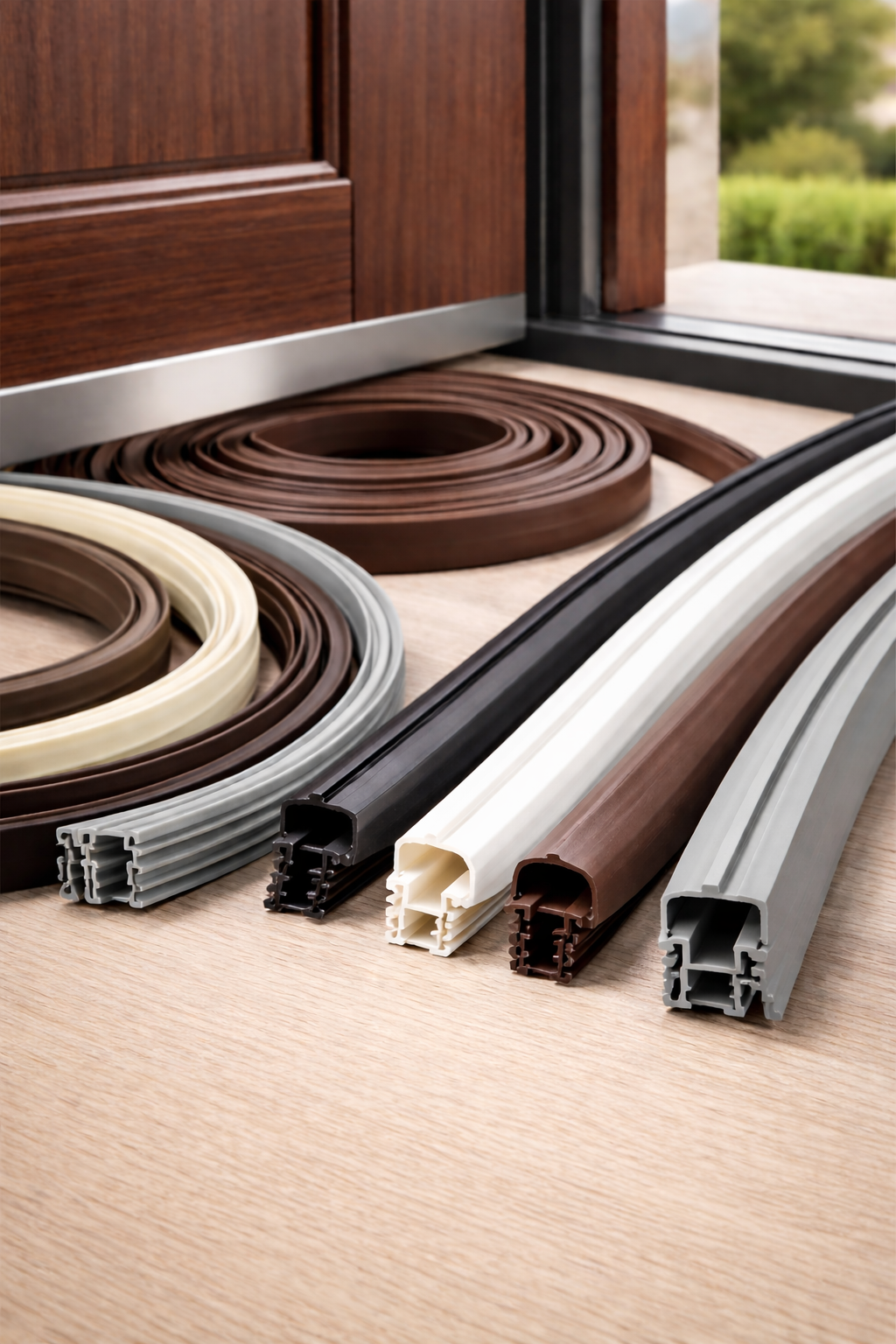
First and foremost, make sure you’re buying a high-quality door seal! In stores, you’ll find products such as:
- seals for sliding doors;
- seals for balcony doors;
- seals for wooden or metal doors;
- seals for interior doors;
- seals for exterior doors.
Although they all serve nearly the same function, each of these types of door seals differs in specifications and dimensions. This is important both for your comfort and for how a specific door is used. Seals for interior doors are offered by manufacturers in a much smaller selection and are generally not suitable for exterior doors. This is due to the specifications, which were designed for much less demanding interior doors—lighter and not exposed to extreme temperatures or moisture from precipitation. Seals for windows and doors cannot be used interchangeably.
Brush seals are a separate category of seals that will help you fully address issues with drafty doors. The purpose of this type of seal is to create a barrier against dust and other debris at the threshold. This solution is also used in interior doors and is especially recommended for rooms where the floor is uneven, resulting in unsightly gaps under the door.
Materials Used to Manufacture Door Seals
- Rubber—the most basic material used to manufacture door gaskets (including those for exterior doors), though it is becoming increasingly rare. Gaskets made from this material are inexpensive, but their performance deteriorates over time, especially in the case of entry doors. In such locations, they are exposed to UV radiation, heat, and cold, which causes the rubber to begin to crumble or crack after a few years.
- Polyvinyl chloride (PVC, PWC, also known by the incorrect but popular abbreviation PCV)—this is currently the most popular and likely the cheapest solution. Unfortunately, it’s also a choice that requires careful consideration. The properties of this material depend primarily on the formulation—PVC gaskets from different manufacturers can vary significantly! The main drawbacks of these gaskets are their low elasticity and limited resistance to external factors. PVC gaskets are most commonly used for windows.
- TPE (thermoplastic elastomers) – they have properties similar to rubber but are characterized by significantly better impact resistance, flexibility (even at low temperatures), and abrasion resistance. This makes them truly durable and ideally suited for use in heavy exterior doors.
- EPDM synthetic rubber – these seals also offer good resistance to adverse weather conditions and extreme temperatures (they can withstand temperatures as low as -30°C), and, above all, good elasticity.
- Silicone rubber – gaskets made from this material are excellent for sealing entry doors. They are highly resistant to aging caused by UV radiation. Their drawback is low resistance to abrasion and exposure to water vapor. This is the best choice for sealing metal doors, such as fire doors—silicone rubber adheres very well to glass and metal.
Installing Seals on Entry Doors
Seals available on the market are almost always self-adhesive, making it easy to ensure that doors and windows are airtight. Sealing exterior doors is not difficult. However, do not ignore the manufacturer’s instructions, and follow the entire process carefully if you want to achieve a tight seal:
- Read the instructions—the adhesive on the seal may require a specific temperature, and sealing doors in the middle of winter may prove ineffective, especially for exterior doors. Try to do this during the summer, or in the fall at the latest.
- Remove the old weatherstrip—if possible, start at the cut line. A flat knife, such as a wallpaper knife, should do the trick. Also, remember to remove any residue from glue or adhesive. Be careful not to damage the door’s finish!
- Clean the surface—not only remove dirt such as dust, but also degrease the surface. If you skip this step, the weatherstrip won’t adhere properly to the door frame.
- Cut the seal to the appropriate length—remember that it’s better to leave a few centimeters of excess than to cut the seal too short. Where horizontal and vertical surfaces meet, cut the material at a 45° angle; a good door seal will then ensure the best acoustic and thermal insulation.
- Install the seal—self-adhesive seals don’t require much effort, but be sure not to stretch them while applying them.
Seals included with Barański Drzwi products
A properly selected seal guarantees adequate insulation. We know this very well, which is why we offer models with highly effective drop-down seals—when the door is closed, the insulating material drops down, ensuring a precise seal for every type of door. For sliding door systems, we also offer ready-made door frame components that come factory-equipped with gaskets.